
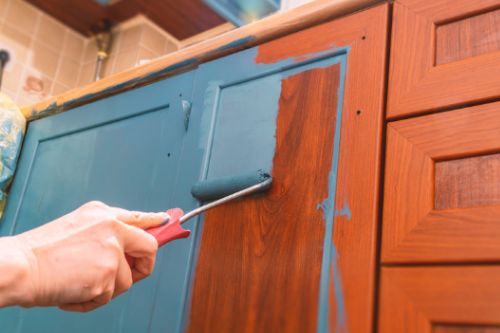
Renovating kitchen cabinets with paint can completely transform a room without dismantling the entire kitchen or replacing the doors, drawers and cabinet units.
It is a particularly attractive option when the cabinets are still functioning properly but their colour, sheen or finish has become outdated.
However, a kitchen places much greater demands on paint than a decorative piece of furniture. Cabinet doors are touched constantly and are exposed to grease, steam, knocks, frequent cleaning and changes in temperature.
For this reason, to paint kitchen cabinets and achieve a durable finish, it is important first to identify the material, degrease thoroughly, prepare the surface, use a compatible primer where required and apply a suitable enamel while respecting its full curing time.
At Bartolomé Bas Pinturas, we have been working in painting and property renovation since 1984 in Jávea/Xàbia and other towns across the northern Costa Blanca. When painting kitchen cabinets, good preparation usually has a greater impact on durability than applying an extra coat of paint.
Get in touch with our experts
Is it worth painting kitchen cabinets?
In many cases, yes.
If the cabinet units are sound, the doors close correctly and the deterioration is mainly aesthetic, painting can radically change the appearance of the kitchen.
A dark wood kitchen can be transformed into a much brighter space. A glossy finish can be changed to satin. An outdated colour can be replaced with off-white, beige, grey, green or any other shade that suits the property.
Painting makes it possible to renovate the kitchen without replacing all the cabinetry.
However, two different situations need to be distinguished.
If the problem is purely aesthetic, painting can be a very effective solution.
If there are boards swollen by water, warped doors, broken hinges, lifting laminate or structural damage, paint will not solve those defects.
Before starting, it is worth applying the same principle we explain in our guide on how to transform old furniture with paint: first check whether the piece is worth renovating, then decide on the painting system.
The first step is to identify what the cabinets are made from
Not all kitchen cabinets are painted in the same way.
A solid wood door does not require exactly the same preparation as a melamine, MDF, veneer or laminate door.
The existing finish also matters.
You may encounter varnished wood, lacquered finishes, old enamel paint, smooth melamine, laminates or surfaces that have already been repainted.
This identification determines whether sanding, keying, sealing, priming or even removing part of the existing finish will be necessary.
Natural or varnished wood usually provides a good base to work with if the existing coating is sound. With melamine and laminates, however, low porosity makes adhesion especially important.
For this reason, it is not advisable to choose the colour first and only then ask how it should be applied.
Grease is the main enemy before painting a kitchen
This point deserves particular attention.
Kitchen cabinet doors accumulate grease even when they look clean.
Areas around handles, ovens, hobs and extractor hoods can collect small amounts of grease, steam and cleaning-product residue over many years.
If you sand directly over that surface, you may spread the contamination.
And if you paint over it, the new coating may struggle to adhere properly.
Before any sanding or priming, the surface should be thoroughly cleaned and degreased using products compatible with both the substrate and the system that will be applied afterwards.
The surfaces should be completely clean and dry.
This is the same principle we follow in any proper surface preparation before painting: good paint cannot compensate for a contaminated base.
Do the doors need to be removed before painting?
Removing the doors and drawer fronts is usually the best option when a uniform finish is required.
Working on each piece separately makes it easier to prepare edges, corners and areas around hinges properly.
It also helps prevent paint build-up.
Before removing them, it is advisable to label each door and its position. Even if they look identical, returning each piece to its original location can help avoid alignment problems.
It is also advisable to remove handles and fittings.
Painting around them usually produces a less clean result.
Do kitchen cabinets need to be sanded before painting?
It depends on the material and the system selected.
The purpose of sanding is not always to remove all the previous paint or varnish.
Often it is enough to reduce the sheen and create a surface that improves adhesion.
When the previous finish is sound, removing it completely may be unnecessary.
However, if there are areas where the paint is lifting, varnish is deteriorated or old layers have built up, these areas will need to be made sound.
If you need to remove previous coatings, our guide on how to remove paint from wood explains the differences between sanding, stripping and other methods.
Extra care is needed with thin veneers to avoid sanding through the surface layer.
Can kitchen cabinets be painted without sanding?
It is possible with certain systems, but the correct answer is: it depends on the substrate and the primer.
There are high-adhesion primers formulated for smooth, low-porosity surfaces that can reduce the need for heavy sanding.
That does not mean they allow you to paint over grease, wax, dirt or a deteriorated finish.
The surface still needs to be prepared correctly.
Sherwin-Williams recommends thoroughly cleaning and degreasing kitchen cabinets before priming and checking adhesion in a test area. See its guide to painting kitchen cabinets.
When kitchen cabinets need primer
Primer can perform several different functions.
On a low-porosity surface it can improve adhesion. On wood it can help even out absorption. On MDF it can seal certain areas. And on some types of wood it can reduce tannin or stain bleed.
It is usually particularly important when working on melamine, laminates, lacquered surfaces, MDF or difficult composite materials.
The key is that the primer must be compatible with both the substrate and the final paint.
Not every primer is suitable for every type of cabinet.
If you are unsure when primer is necessary, you can read more in our guide on how to know whether a surface needs primer before painting.
What paint should be used for kitchen cabinets?
A kitchen needs a durable finish.
Conventional wall paint should not be used on cabinet doors and drawer fronts.
For this type of work, enamel paints or coating systems designed for furniture are usually used because they provide good adhesion, resistance to wear and ease of cleaning.
Modern water-based enamels can provide a very suitable finish for interior furniture, provided they are formulated for that use.
There are also two-component systems and other higher-performance finishes for more demanding applications.
The choice should be based on the substrate, the intended use and the desired final result.
Our guide to the different types of paint and how to choose the right one explains why the product should be selected according to the surface rather than simply the visual finish.
Matt, satin or gloss: which finish works best?
On kitchen cabinets, the sheen level also affects maintenance.
Completely matt finishes can create a modern look, but some formulations may show marks more easily with use.
Satin often provides a good balance between appearance, durability and ease of cleaning.
Gloss finishes reflect more light and can create a very clean appearance, although they also make some preparation defects more visible.
There is no single answer that suits every kitchen.
The important thing is to choose an enamel with sufficient resistance for frequently used furniture.
How to apply the paint for an even finish
Once the surface has been prepared and primed, the finishing coats should be applied in thin layers.
Trying to achieve full coverage in a single coat usually produces poorer results.
An excessively thick coat can lead to marks, runs and uneven drying.
Depending on the product and the finish required, a roller, brush or spray gun can be used.
For a finish closer to a lacquered appearance, professional spray application can provide particularly even levelling.
However, perfect application cannot compensate for poor preparation.
If there is grease underneath or an old coating with poor adhesion, the new finish will eventually fail.
Curing is more important than it may seem
One of the most common mistakes when renovating kitchen cabinets is using them again too soon.
Paint can be touch-dry without having reached its final hardness.
During curing, the coating gradually develops its full resistance.
Closing doors forcefully, fitting handles immediately, placing objects on the surface or cleaning aggressively can leave marks during the first few days.
The curing time specified by the manufacturer should always be respected.
There is no single curing period that applies to every enamel.
Do cabinets need to be varnished after painting?
Not necessarily.
Many furniture enamels are formulated to work as the final finish and do not require an additional coat of varnish.
Applying an unnecessary protective coating may even alter the colour, sheen or texture.
Other systems may allow or require an additional protective coat.
The decision should be based on the technical data sheet and product compatibility.
Primer, paint and varnish should not simply be mixed because each product is marketed as durable.
They need to work together as a system.
What about worktops, cabinet interiors and areas near heat?
Painting doors and drawer fronts does not mean every kitchen surface can be treated in the same way.
Worktops are exposed to water, food, heat, chemicals and much more intense abrasion.
They therefore require specific coating systems.
Conventional enamel should also not be used in areas that may reach temperatures above the limits specified by the manufacturer.
Cabinet interiors can be painted, but it is worth considering whether this is really necessary. Curing time and friction from stored objects also need to be taken into account.
Renovating wood cabinets compared with melamine
The difference between these substrates is important.
Wood usually allows more straightforward preparation because it can be sanded and provides a surface with greater potential for mechanical adhesion.
If the cabinet is varnished, it is normally cleaned and keyed before the appropriate system is applied.
Melamine and laminate surfaces are much less porous.
Here, preparation and a suitable bonding primer become even more important.
In both cases, the result can be very good if the materials are sound.
For wooden furniture and joinery, we also provide professional wood treatment and renovation according to its condition and original finish.
What colour should you choose when renovating a kitchen?
A change of colour can transform the room much more than it may seem.
Whites and light shades can help make the kitchen feel brighter, although not every old kitchen needs to be turned white.
Sand, stone, soft grey, olive green or blue-grey shades can work very well depending on the worktop, flooring and natural light.
In larger kitchens, combining two colours can also be effective, for example using one shade on lower cabinets and a lighter one on upper units.
When a shade needs to be matched to existing elements, we offer custom colour creation for painting projects.
Painting kitchen cabinet doors is similar to painting a wooden door, but not exactly the same
A cabinet door and an interior door share many of the same principles: cleaning, preparation, priming and finishing.
However, kitchen cabinets are exposed to more grease and constant handling.
This means particular attention must be paid to degreasing and final durability.
If your cabinets are made of wood, our guide on how to paint wooden doors correctly can help you better understand surface preparation and application of the finish.
The mistakes that most reduce the life of the finish
Problems usually arise because the surface was prepared poorly, not because the wrong colour was chosen.
Painting over grease is one of the most serious mistakes.
Other common problems include using the wrong primer, failing to respect drying times or using the kitchen before the enamel has fully cured.
Another common mistake is assuming that “furniture paint” automatically means “suitable for every material”.
A melamine door needs different preparation from a natural wood door.
When is painting worthwhile and when is replacement a better option?
Painting is particularly worthwhile when the structure is still in good condition.
If the cabinet units, doors and drawers all function correctly, renewing the finish can give the kitchen a second life.
It also allows you to keep a layout that already works without carrying out unnecessary renovation work.
Replacement may make more sense when boards are swollen, there is serious moisture damage, doors are warped or the existing layout no longer meets the needs of the property.
Paint renovates.
It does not rebuild structurally damaged cabinetry.
Kitchen cabinet renovation in Jávea and the Costa Blanca
In homes in Jávea/Xàbia, Dénia, Moraira, Benitachell and other nearby towns, we often find kitchens where the cabinets are still functioning correctly after years of use but the finish no longer suits the current style of the property.
Repainting them can update the kitchen without replacing all the cabinetry.
Before starting, it is important to assess the material, the existing finish, its condition and which system will provide the best adhesion and durability.
If you are unsure which paint to use, we offer professional advice on choosing paints and primers adapted to each substrate.
At Bartolomé Bas Pinturas, we also carry out professional house painting and renovation work in Jávea and other towns across the northern Costa Blanca.
In summary: how to renovate a kitchen with paint without replacing the cabinets
The result depends on treating the cabinet as a complete system, not simply as a surface whose colour you want to change.
First, identify the material and check that it is sound. Then clean and degrease it thoroughly, prepare the existing finish and apply a compatible primer where required.
Next, use an enamel suitable for furniture, applied in thin coats, while respecting both the intervals between coats and the full curing time.
If the cabinets are in good condition, painting them can transform the kitchen without replacing them; the key to making the change last lies in preparation and compatibility between the substrate, primer and finishing coat.
Frequently asked questions about painting kitchen cabinets
Can kitchen cabinets be painted without sanding?
With certain systems, yes, especially when high-adhesion primers are used. However, the surface must always be thoroughly cleaned and degreased. The existing finish must be sound and the manufacturer must approve that application system.
What paint is best for kitchen cabinets?
An enamel paint or coating system designed for furniture and capable of withstanding frequent cleaning and wear should be used. The exact choice depends on the material, the previous finish and the level of resistance required.
Do kitchen cabinets need primer before painting?
Not always, but primer is usually advisable on melamine, laminates, MDF, lacquered surfaces, untreated wood or other difficult substrates. The primer must be compatible with both the cabinet surface and the final paint.
Can melamine kitchen cabinets be painted?
Yes. Melamine can be painted if it is firmly adhered and is correctly cleaned, degreased and prepared. Because it has low porosity, a high-adhesion system compatible with this material is usually used.
How long does kitchen cabinet paint take to dry?
It depends on the product and the environmental conditions. It is important to distinguish between touch-dry time, recoat time and full curing time. The cabinets should not be subjected to heavy use until the enamel has reached the resistance specified by the manufacturer.
Do kitchen cabinets need varnish after painting?
Not necessarily. Many furniture enamels are designed to work as the final finish. An additional protective coat should only be applied when the system is designed for it and the products are compatible.
Is it better to paint kitchen cabinets with a roller or spray gun?
Both methods can produce good results. A roller offers greater control, while spray application can provide a more uniform finish similar to a lacquered surface when carried out correctly.
Is it worth painting an old kitchen?
Yes, when the cabinet structure and doors are still in good condition and the main issue is aesthetic. If there are swollen boards, deformation or significant damage, repairing or replacing the affected parts may be more appropriate.

Bartolomé Bas
Professional painter in Jávea since 1984, specialising in decorative painting, waterproofing, renovations and damp treatment. Founder of Bartolomé Bas Pinturas. More than 35 years of experience transforming homes and business premises on the Costa Blanca.
Professional profiles:
How to Paint Bathroom or Kitchen Tiles and Achieve a Durable Finish
Yes, aluminium windows can be painted , even when they have a factory-applied coating, but the final result mainly depends on three factors: proper cleaning, preparation that promotes good adhesion and a primer that is compatible with aluminium. Painting directly over…
Can Aluminum Windows Be Painted? Preparation, Priming, and Finishing
Yes, aluminium windows can be painted , even when they have a factory-applied coating, but the final result mainly depends on three factors: proper cleaning, preparation that promotes good adhesion and a primer that is compatible with aluminium. Painting directly over…
How to tell if a wall needs priming before painting
Finding a crack in a façade just when we are thinking about repainting it raises a logical question: is it enough to fill it and paint over it, or does something else need to be done? The answer depends on the type of fissure, what caused it and, above all, whether it…